Start with the whole exchange
A single sentence can look very different when it is separated from the messages around it. Read the relevant sequence before analyzing a suspicious text. Keep speaker labels, dates, and earlier plans when they change the meaning.
If you have only a fragment, say so. An incomplete conversation may justify a question, but it usually cannot support a confident story about what happened.
1. Name the exact observation
Describe the detail without adding intent. “The first message says the meeting ends at six; the later message says work continued until eight” is an observation. “They are obviously lying” is an interpretation.
Also separate a plan from a record of what happened. “I expect to finish at six” can be honest even if the meeting later runs until eight.
2. Mark what is missing
Write down which facts could change your read. Was the time approximate? Did the plan change? Are the messages from different days or time zones? Could a joke, quoted message, or missing screenshot explain the wording?
Do not fill a gap with the most painful explanation. Keep it labeled as unknown until evidence resolves it.
3. Compare more than one explanation
Write one concerning explanation and at least one ordinary explanation that fits the same facts. This does not dismiss your concern. It shows what additional detail would distinguish the possibilities.
4. Check the communication pattern
One short reply may mean avoidance, work, fatigue, or simply a person’s usual style. Compare it with the surrounding conversation and with patterns you can actually point to. Tone by itself is easy for both people and AI to misread.
5. Ask a question tied to the detail
“You mentioned finishing at six, then working until eight. Did the meeting run late?” is easier to answer than “Why are you lying to me?” It names the inconsistency without pretending the evidence has already settled the issue.
6. Use AI as a second pass
AI can summarize a long exchange, identify apparent inconsistencies, and suggest questions you may have missed. It can also misread screenshots, swap speakers, miss sarcasm, or make unsupported inferences.
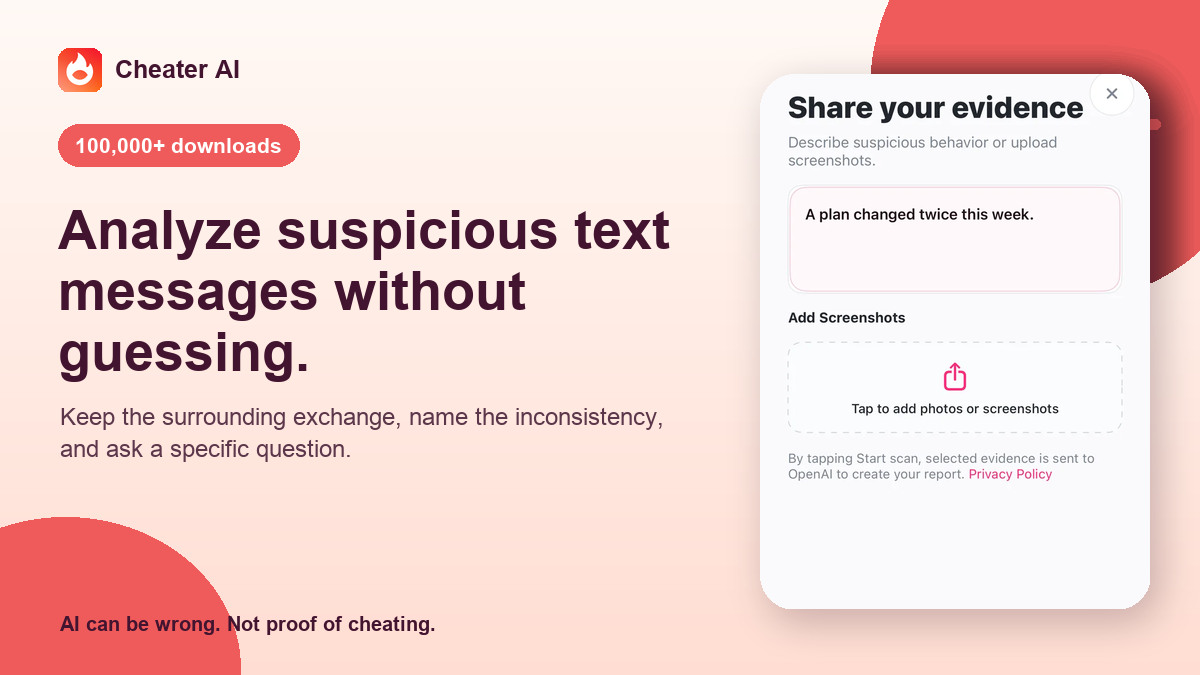
In Cheater AI, add the relevant screenshots or pasted messages and explain the situation. Then check each important output against the original evidence. Full cloud analysis requires a subscription and your permission.
A useful outcome is a clearer question
A report does not need to deliver a dramatic verdict to be useful. Sometimes the accurate result is that one detail needs clarification and the available evidence cannot support more.
See the method in practice
Read the fictional Cheater AI report to see how two apparently conflicting times become an observation, alternative explanations, and a specific question.
Sources and limits
The Cheater AI product team uses these public sources to explain factual limits responsibly. They do not imply clinical, therapeutic, legal, or other professional review of this guide.
- Accuracy of deception judgments, PubMed record
Research record supporting caution about deciding whether someone is lying from behavioral cues alone.
- NIST AI Risk Management Framework
A framework for managing AI limits and trustworthiness rather than treating an output as a verdict.